
Commercial construction in the United States operates under tight schedules, strict compliance requirements, and high financial exposure. In this environment, natural stone is not simply a finish material – it becomes part of the structural, aesthetic, and long-term value proposition of the project.
From office towers and mixed-use developments to hospitality, healthcare, and institutional buildings, natural stone must meet technical, logistical, and contractual standards that differ significantly from residential supply.
This article examines how natural stone supply functions within U.S. commercial construction and what procurement teams, developers, and contractors should evaluate before committing to a supplier.
-
The Role of Natural Stone in Commercial Projects
In commercial construction, natural stone is typically specified for:
- Exterior cladding and ventilated facades
- Lobby and public-area flooring
- Elevator surrounds and feature walls
- Restroom and hospitality surfaces
- Hardscape and landscape applications
Unlike residential installations, commercial projects often involve:
- Large continuous volumes
- Strict dimensional tolerances
- Phased delivery schedules
- Formal submittal and approval processes
Stone becomes part of the specification package, often referenced in architectural drawings and procurement documentation.
-
Specification and Compliance Requirements
In U.S. commercial construction, materials are rarely selected based on appearance alone. Architects and engineers evaluate:
- ASTM test results
- Compressive and flexural strength
- Water absorption rates
- Freeze-thaw performance
- Slip resistance ratings
- Fire performance data
Standards from organizations such as ASTM International and the Natural Stone Institute often influence specification requirements.
Failure to provide proper technical documentation can delay approvals or disqualify a supplier from bidding.
For large projects, submittal packages may include:
- Quarry origin documentation
- Slab photography and lot numbers
- Material test certificates
- Mockup samples for approval
A professional stone supplier must operate with the same documentation discipline as other structural material providers.
-
Quarry-Direct Sourcing and Material Consistency
Commercial projects require material consistency across hundreds or thousands of square feet. This makes quarry-direct sourcing critical.
Advantages of direct quarry or controlled-block sourcing:
- Color and vein continuity
- Controlled extraction sequence
- Ability to reserve blocks for phased projects
- Better pricing transparency
- Reduced intermediary risk
For large commercial volumes, sourcing must be coordinated at the block level, not just at the slab level. Otherwise, shade variation between batches can become a major risk.
-
Container-Based Logistics and U.S. Distribution
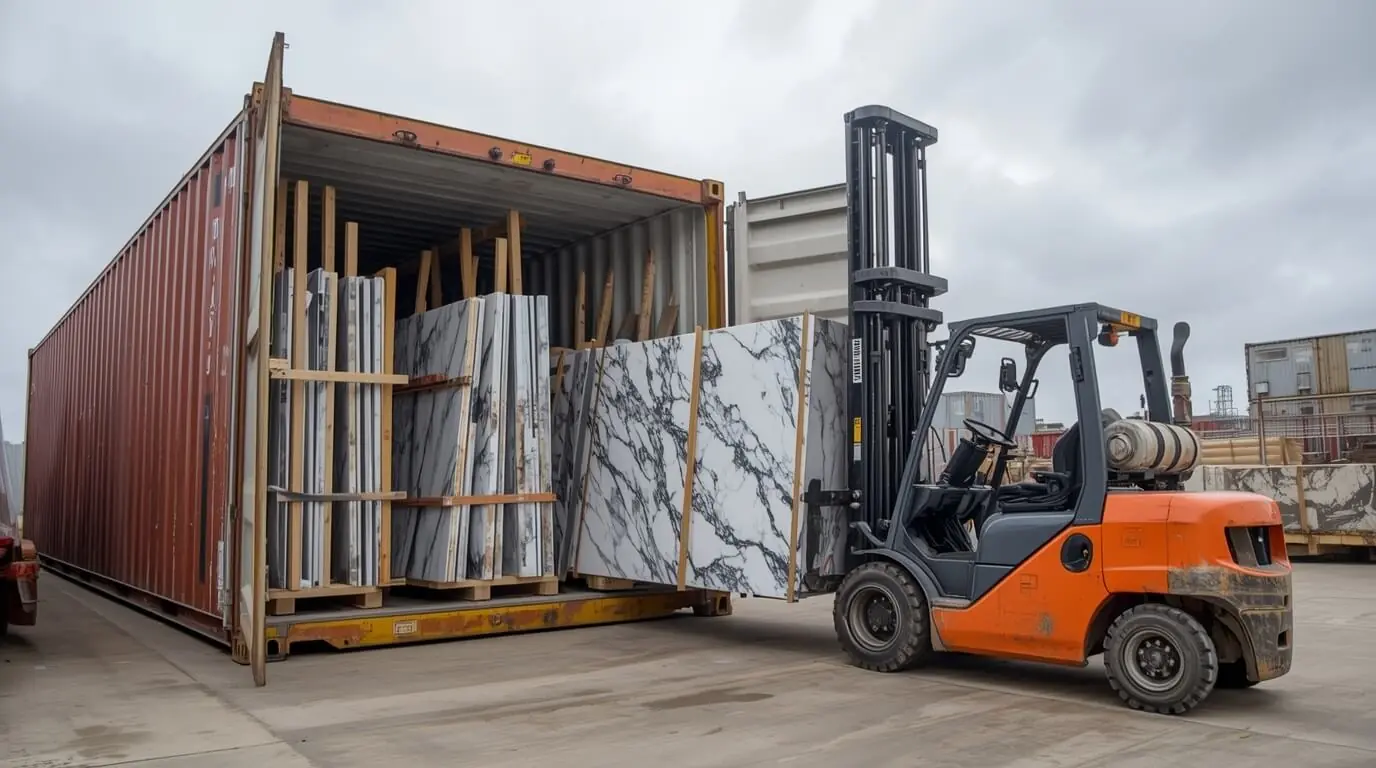
Most imported natural stone for commercial projects arrives via containerized ocean freight.
A typical supply chain includes:
- Block extraction
- Slab production and quality control
- Container loading
- Ocean freight to U.S. port
- Customs clearance
- Inland trucking to warehouse or job site
For time-sensitive projects, suppliers must:
- Plan lead times 8–12 weeks in advance
- Maintain buffer inventory
- Coordinate split shipments when required
- Align delivery with construction phases
Delays at port or production can impact project timelines. Experienced suppliers mitigate this through advance planning and transparent communication with contractors and procurement teams.
-
Risk Management in Commercial Stone Procurement
Commercial procurement teams evaluate more than price per square foot.
Key risk factors include:
- Supplier financial stability
- Production capacity
- Backup quarry access
- Insurance and liability coverage
- Contract clarity
Unlike small retail orders, commercial stone supply often involves container-level commitments and staged payments. Contract structure must protect both sides.
Procurement departments may require:
- Credit checks
- Insurance certificates
- Performance guarantees
- Detailed commercial terms
Suppliers that understand construction risk culture integrate these elements into their operations.
-
Lead Times and Project Phasing
Commercial construction rarely happens in a single delivery phase.
Stone supply may be divided into:
- Mockup phase
- Initial facade shipment
- Interior installation batch
- Replacement or contingency material
Suppliers must reserve additional volume from the same block or quarry to maintain continuity.
Without controlled planning, matching material months later can become impossible.
-
B2B Communication and Documentation Standards
In commercial construction, communication is formal and structured.
Typical interactions involve:
- RFQs with detailed scope
- Submittal tracking
- Purchase order referencing
- Change order documentation
- Inspection and punch-list coordination
A professional stone supplier operates within this framework rather than in informal retail-style communication.
Clear documentation reduces disputes and protects long-term relationships.
-
The Strategic Value of a Reliable Stone Supplier
Natural stone represents a visible, permanent element of a commercial building. Mistakes in sourcing can result in:
- Color mismatch across elevations
- Installation delays
- Budget overruns
- Replacement costs
By contrast, structured quarry-direct sourcing, container-level logistics control, and technical compliance support can:
- Reduce procurement risk
- Stabilize budgets
- Improve installation workflow
- Support long-term building performance
In U.S. commercial construction, natural stone supply is not a commodity transaction. It is a coordinated operational function that connects quarry extraction, international logistics, compliance documentation, and on-site execution.
Developers, contractors, and procurement managers who treat stone supply as a strategic component rather than a last-stage purchase significantly reduce project risk.