The rebuilding of a home after a wildfire is not simply a process of replacing what was lost. It creates an opportunity to reconsider materials, architecture, durability, and the relationship between a building and its environment.
This is particularly relevant across Southern California, where reconstruction following major wildfires is reshaping residential neighborhoods and creating new conversations around material selection.
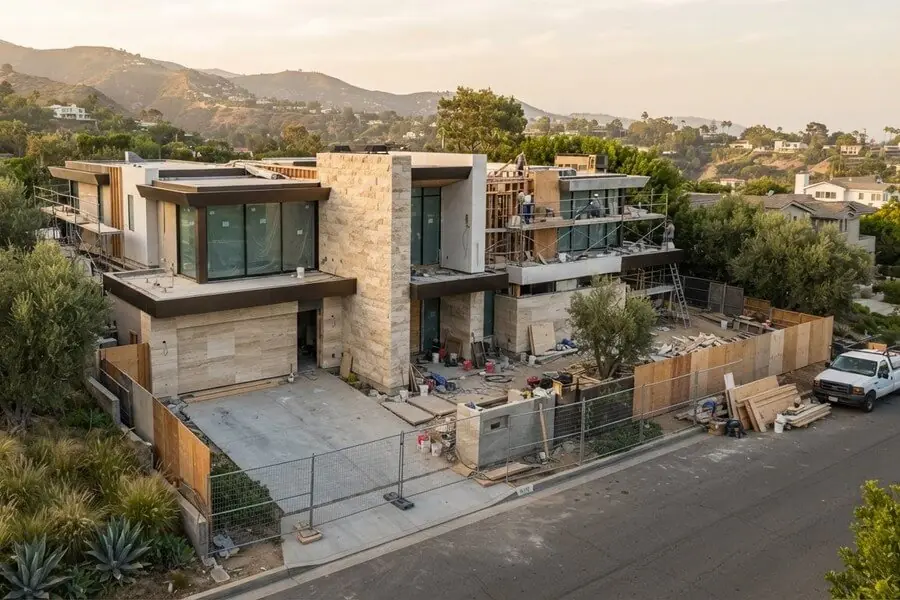
In Pacific Palisades, rebuilding after the January 2025 fire is now well underway. Homes and other structures damaged or destroyed by the fire are moving through dedicated and expedited rebuilding processes, while architects, contractors, and homeowners are making decisions that may define these properties for decades.
Looking for reliable stone supply?
We organize direct quarry sourcing from Turkey with container-based delivery across the U.S. Structured for fabricators, contractors and project-based supply.
Natural stone can play an important role in that process.
Travertine, limestone, marble, granite, and other stones offer more than a particular visual language. They allow architects to work with a mineral material that can be specified for exterior and interior applications, fabricated to project dimensions, and sourced specifically for an individual residence.
For California rebuild projects, the question is therefore not simply which stone to choose. It is how the material will be used, detailed, fabricated, and delivered as part of the architecture.
Rebuilding in Pacific Palisades
The scale of reconstruction in Pacific Palisades has created an unusual architectural moment.
Rather than isolated renovations or individual new homes, an established residential community is rebuilding many properties within the same period. Some owners are recreating what existed before. Others are using the opportunity to rethink layouts, materials, exterior spaces, and the overall character of their homes.
At the same time, rebuilding takes place within updated requirements and a broader emphasis on resilience. Material decisions must therefore be considered alongside building codes, site conditions, fire-resistant construction strategies, and the specifications established by architects and engineers.
Natural stone does not replace those systems. It becomes one material within them.
Its value lies in the range of architectural roles it can perform and in the ability to select the appropriate stone, finish, dimensions, and fabrication method for each application.
Where Natural Stone Fits into a California Home
Southern California architecture often creates a relatively fluid transition between interior and exterior spaces.
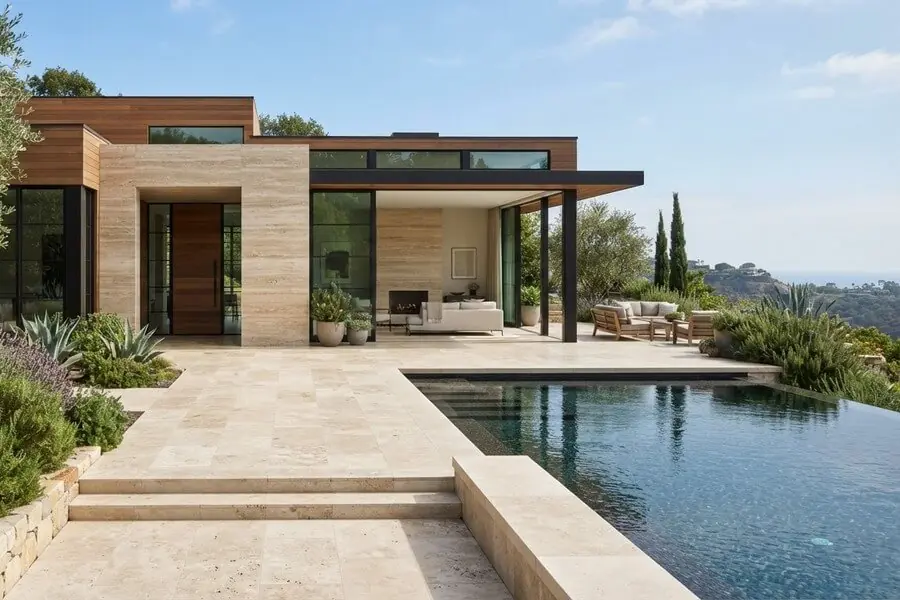
Terraces connect to living areas. Pools become part of the architecture rather than isolated landscape elements. Exterior walls continue into courtyards. Large openings visually connect interior flooring with outdoor surfaces.
Natural stone works particularly well in this type of environment because the same material family can appear at different scales and in different parts of a property.
Typical natural stone applications in residential projects can include:
- exterior wall cladding
- architectural facades
- entry areas
- terraces and patios
- pool surrounds
- exterior and interior flooring
- stairs and steps
- fireplaces
- bathrooms
- wall panels
- landscape elements
- custom-cut architectural pieces
The appropriate material and finish can vary considerably between these applications.
A stone selected for an interior wall does not automatically make it suitable for an exposed pool deck. A polished finish that works in a bathroom may be inappropriate for an exterior walking surface. Thickness, finish, porosity, edge treatment, installation system, exposure, and maintenance all need to be considered as part of the specification.
This is why natural stone selection is most effective when it begins with the application rather than with color alone.
Travertine and the Southern California Context
Among natural stones, travertine has a particularly established relationship with warm-climate residential architecture.
Its visual character can range from quiet and relatively uniform to highly directional, depending on the quarry, block, cut, and finish. Beige, cream, silver, walnut, and other tonal families allow it to work with architecture ranging from restrained contemporary homes to more traditional Mediterranean influences.
Travertine can also be processed in substantially different ways.
Vein-cut material emphasizes linear geological movement. Cross-cut travertine produces a more clouded and open pattern. Honed, brushed, filled, unfilled, and other finishes further change how the same stone reads within a project.
This flexibility makes travertine relevant to more than one architectural element.
Large-format pieces may establish broad continuous surfaces. Cut-to-size material can define elevations and architectural details. Pavers can extend the material into exterior areas. Steps, coping, thresholds, wall pieces, and other fabricated components can allow the same material language to continue throughout the property.
The result does not need to be a house covered in travertine.
Often the stronger approach is selective use: identifying the architectural surfaces where natural material has the greatest visual and functional impact.
Beyond Travertine
California residential projects are not limited to one type of stone.
Limestone can provide quieter surfaces with relatively restrained movement, making it particularly useful when the architecture rather than the stone is intended to dominate the composition.
Marble and dolomite can introduce stronger veining and greater visual contrast in selected interior applications, fireplaces, bathrooms, feature walls, and custom architectural elements.
Granite and other dense stones may be considered where their particular physical characteristics are appropriate to the intended application.
The important distinction is that natural stone should not be treated as a generic category.
Different geological materials behave differently. Even stones sold under the same commercial family can vary in absorption, density, surface characteristics, mineral composition, and suitability for particular environments.
Material selection should therefore be based on the actual stone and intended application rather than the name alone.
Sourcing Stone Directly for a Rebuild Project
One of the less visible decisions in a residential project is how the stone reaches the site.
For smaller quantities, selecting material already available through a local distributor can be the simplest solution. For larger or more specific projects, direct international sourcing creates another option.
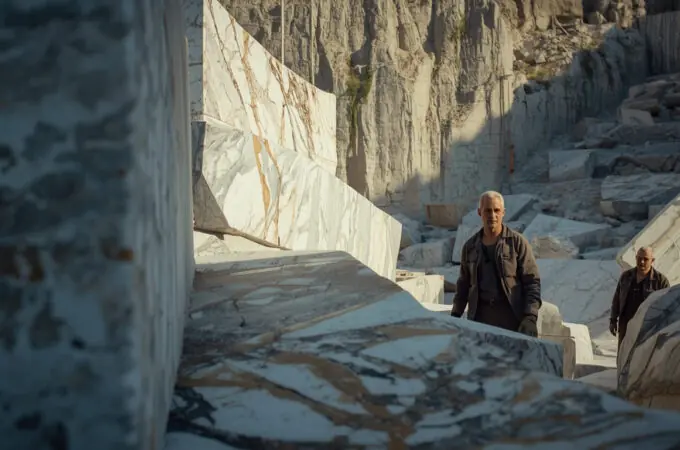
Turkey is one of the world’s significant sources of travertine, limestone, marble, and other natural stones. For a California residential project requiring substantial quantities or project-specific fabrication, stone can be selected and produced in Turkey before being shipped to the United States.
This changes the procurement process.
Instead of designing exclusively around material currently available in a local warehouse, the project team can begin with the architectural requirement and source accordingly.
Depending on the project, natural stone supply may include blocks or slabs, standard-size material, cut-to-size pieces, pavers, steps, wall elements, coping, or components fabricated according to project drawings.
For larger projects, several of these elements can be coordinated within the same material selection.
That can be particularly valuable when continuity matters.
Stone used around a pool, across a terrace, on exterior walls, and in selected interior areas may need to relate visually even when the dimensions and finishes differ.
From Quarry Selection to Fabrication
Direct sourcing does not mean simply choosing a stone name from a catalog.
Natural stone varies from block to block.
Veining may become stronger or quieter. Background color can shift. Fossils, pores, mineral deposits, tonal movement, and other geological characteristics can change across different sections of the quarry.
For architecturally significant projects, selection therefore benefits from being considered at the block, slab, or production-batch level.
Once a material has been selected, fabrication can be coordinated around the project schedule and drawings.
This may involve different thicknesses, dimensions, surface finishes, edge details, and packaging requirements for different areas of the same residence.
The earlier these requirements are defined, the easier it becomes to coordinate production efficiently.
Architects, Designers, Contractors, and Homeowners
Stone decisions rarely belong to one participant alone.
An architect may establish the material concept and dimensional logic. An interior designer may determine how the material continues through interior spaces. A landscape designer may introduce related stone into terraces, pools, and exterior areas. A contractor must ultimately coordinate installation, sequencing, access, and site conditions.
The homeowner brings another perspective: how the material should feel and age over years of use.
For this reason, successful stone procurement depends on communication between the different professionals and clients involved in the project.
A beautiful material selected without considering installation may create unnecessary complications. A technically appropriate stone selected without considering variation may not produce the intended visual result.
The strongest projects align both sides early.
Shipping Natural Stone from Turkey to California
International stone supply also requires logistics to be considered from the beginning.
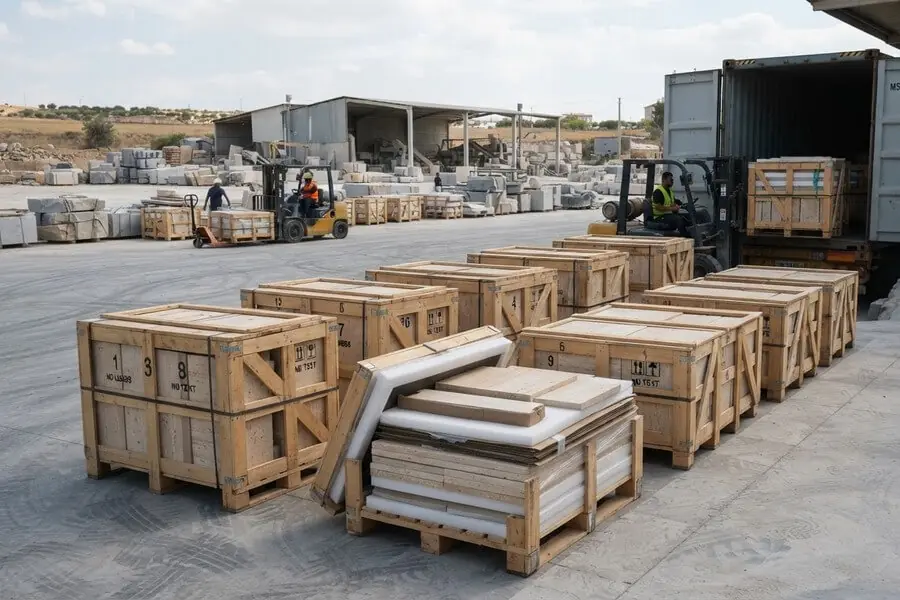
Natural stone is unusually heavy relative to its volume. Container planning is therefore driven not only by physical space but by weight limits, packaging, inland transportation requirements, and unloading conditions at the destination.
For shipments from Turkey to California, the process can include inland transportation from the factory, export handling, container loading, ocean freight, U.S. customs clearance, port handling, inland drayage, and final delivery.
The final destination matters.
Delivering a container to an established stone yard with appropriate unloading equipment is different from delivering material to a residential construction site in Los Angeles.
Access restrictions, staging space, unloading equipment, container waiting time, and the ability to store crates safely should all be considered before shipment.
For rebuild projects in areas such as Pacific Palisades, site logistics can be especially important because construction activity, hillside conditions, street access, and restrictions on the use of public space may affect how and when materials can be delivered.
A successful shipment is therefore not complete when the container reaches California. It is complete when the material can be received safely and practically by the project team.
Planning Stone Early in the Project
Natural stone is easier to integrate when it is considered early.
Waiting until construction is advanced can reduce the available choices and force the project team to select material based primarily on immediate availability.
Earlier planning allows time for material evaluation, samples, quantity calculations, fabrication drawings, production, packing, international transportation, and coordination with the construction schedule.
It also allows related applications to be considered together.
If the project will eventually require exterior paving, pool coping, steps, wall cladding, and interior stone, those requirements can be evaluated as one material program even when the individual components are produced or installed at different stages.
This can improve visual continuity and reduce the risk of trying to match a natural material much later.
Rebuilding with Materials That Endure
A rebuilt home carries a particular significance.
It replaces something that was lost, but it also becomes part of the next chapter of the property and the surrounding community.
Natural stone is well suited to architecture conceived on that timescale. Its surface does not remain visually identical forever. It responds to use, weather, light, water, and maintenance. Those changes are part of the material rather than an attempt to imitate one.
For architects and homeowners rebuilding in Pacific Palisades and elsewhere in California, this makes stone worth considering not simply as a finish, but as part of the long-term material character of the home.
The objective is not to use natural stone everywhere.
It is to use the right stone, in the right application, with the right fabrication and detailing, and to plan its journey from source to site as carefully as any other part of the architecture.