In the United States, minimum order quantities for wholesale marble slabs are determined by quarry operations, production economics, and container logistics. They are not arbitrary commercial thresholds. They reflect how marble is extracted, processed, shipped, and financed within the global stone trade.
For fabricators, slab yards, distributors, and commercial contractors, understanding how MOQs function is essential before entering quarry-direct or container-based procurement programs.
This article explains how wholesale marble MOQs are structured in the U.S. market and how they influence procurement planning.
Why Minimum Order Quantities Exist in Marble Supply
Marble is extracted in large quarry blocks and processed in production batches. Each stage of the supply chain involves operational costs that cannot be efficiently distributed across very small quantities.
Quarry Extraction and Block Processing
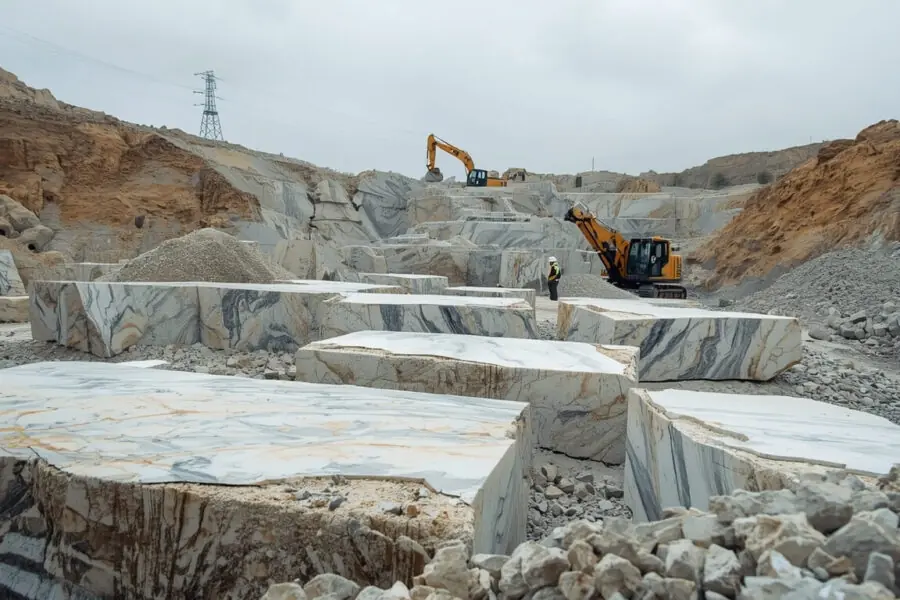
Marble production begins at the block level. Blocks are extracted, transported to processing facilities, and cut into slabs in defined production runs. Interrupting this flow for small custom quantities increases waste, disrupts scheduling, and raises cost per square foot.
Because of this, suppliers structure orders around block yield and factory production cycles rather than individual slab requests.
Container-Based Freight Economics
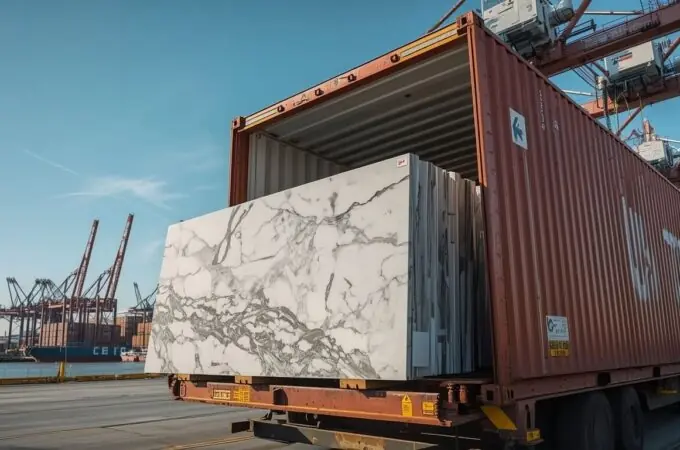
International marble trade is structured around containerized shipping. Ocean freight is calculated per container, not per pallet or partial volume. A partially filled container increases landed cost significantly and weakens pricing stability.
As a result, many wholesale programs define the minimum order at one full container load. This ensures freight efficiency and predictable cost distribution.
Financial and Administrative Risk Management
Wholesale marble transactions often involve production deposits, international payments, insurance coverage, and coordinated logistics. Fragmented small orders increase administrative complexity and financial exposure for both parties.
Minimum order quantities stabilize transaction structure and reduce operational risk.

Typical MOQ Structures in the U.S. Wholesale Market
MOQ frameworks vary depending on the supply model, but most fall into one of three structures.
Full Container Load Programs
The most common structure in quarry-direct marble trade is a full container load commitment. A 20-foot container typically carries multiple bundles of slabs, with total square footage depending on thickness and material density.
This model allows suppliers to maintain color consistency within a defined lot while preserving freight efficiency. It also provides buyers with predictable landed pricing.
Block-Level Allocation for Commercial Projects
In large commercial projects, MOQs are sometimes structured at the block level rather than at the container level. In this scenario, specific quarry blocks are reserved for the project, and slabs are produced in scheduled phases.
This approach ensures material continuity across facade systems, lobby installations, or multi-stage developments where visual consistency is critical.
Domestic Warehouse-Based Orders
When marble is already stocked in U.S. warehouses, some suppliers offer smaller order volumes. These are not quarry-direct allocations but secondary distribution from existing inventory.
Such orders may involve higher pricing and limited selection, as material is restricted to what is currently available in stock.
Factors That Influence Marble MOQ Requirements
Minimum order levels are influenced by operational, logistical, and visual considerations.
Production Planning and Factory Efficiency
Marble factories operate in cutting sequences designed around block yield. Small custom volumes disrupt that sequence and increase waste.
Freight and Logistics Structure
Ocean freight economics favor full container loads. Partial shipments distort cost structure and complicate customs and inland transport coordination.
Material Consistency and Lot Control
Marble is a natural material with inherent variation. Orders spread across multiple production lots increase the risk of shade differences and vein mismatch. For commercial or high-visibility applications, this creates installation risk.
Capital Exposure and Payment Terms
International marble supply often involves structured payment terms. Concentrating volume into defined orders reduces transactional fragmentation and improves financial predictability.
Differences Between Residential and Commercial Procurement
Retail marble purchases typically involve one or two slabs for residential countertops or small interior applications. These transactions are usually fulfilled from domestic slab yards.
Commercial and fabrication buyers operate under different requirements. They need lot control, reorder continuity, margin predictability, and long-term allocation planning. Their procurement decisions are structured around project scope and installation schedules rather than individual pieces.
As a result, wholesale MOQs reflect professional buying behavior rather than residential demand patterns.
Lead Times and Planning Considerations
Imported marble supply requires advance planning. Production scheduling, factory backlog, ocean transit time, and port clearance all contribute to total lead time.
Minimum order commitments must be aligned with construction schedules. Late-stage material selection increases the risk of price volatility, limited availability, and extended delivery timelines.
Buyers who align MOQ decisions with early-stage planning maintain stronger cost control and reduce schedule disruption.
Strategic Evaluation for Fabricators and Distributors
Before entering a wholesale marble program, professional buyers should assess how MOQs are structured and whether the supplier controls quarry sourcing directly.
It is important to understand whether additional matching material can be secured later, how replacement slabs are handled in case of damage, and how production continuity is maintained across multiple shipments.
Transparent communication regarding these issues separates structured B2B supply programs from opportunistic trading operations.
The Role of MOQ in Protecting Material Integrity
Minimum order quantities are not designed to exclude buyers. They are designed to protect supply integrity.
When aligned with quarry operations and container logistics, MOQs support color consistency, freight efficiency, pricing stability, and predictable execution.
In the U.S. wholesale marble market, procurement aligned with production realities leads to fewer disputes, stronger margins, and more stable long-term supplier relationships.
Marble is not a small-batch commodity. It is a block-based natural material distributed through structured international logistics. Buyers who understand this framework position themselves for sustainable and scalable procurement.